
Phrenology
At its beginnings, phrenology held a lofty position in science as a medical discipline. However, today phrenology is examined only as a pseudoscience and practiced as a form of character divination.
Franz Josephe Gall, the Founder of Phrenology
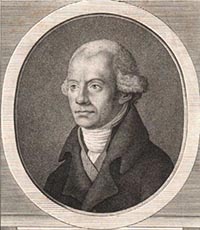
Historians call the 18th Century "The Age of Reason and Enlightenment." It was an era of intellectual and philosophical development when humans began moving away from medieval practices and superstitions and sought rational explanations in their explorations of the state, society, and the individual5. Franz Joseph Gall, the founder of phrenology, was born in the middle of this era on March 9, 1758.
Even as a young man, Gall began to correlate personality features with prominent physical characteristics. During medical training at Strasbourg, Gall noticed that his smartest classmates had bulging eyes and attributed their brilliance to, what he believed, was enhanced cerebral function directly behind their eyes2. This early theory formed the basis for Gall's theory of phrenology.
After completing his medical studies, Gall's passion remained in linking brain function with physical features. He visited asylums, courts, prisons, and castles to find people with specific personality traits, linking them to pronounced physical characteristics.
Gall's Theory of Phrenology
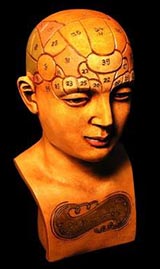
Gall believed that the brain was the organ of the mind and composed of 27 different "sub-organs" that governed different dispositions and inclinations, that an individual's moral and intellectual faculties are innate and how an individual originally expresses those faculties depends on the organization of the person's brain. He proposed that development of an individual's mental faculties would lead to further growth in the sub-organs responsible for them and that this growth caused changes in the structure of the skull6. He believed that a person's character and abilities could be recognized by palpating the skull and locating the position of bumps and indents along its surface.
Gall called his new science "Cranioscopy". At its introduction in 1796, it was hailed as the latest advancement in neurology and welcomed as a powerful diagnostic tool. In 1800, Johann Christoph Spurzheim joined Gall as a research assistant and collaborator. Spurzheim and followers were largely responsible for the name change to Phrenology.
Spurzheim somewhat reorganized and refined Gall's original list and added 10 faculties, creating a list of 37 brain "organs":
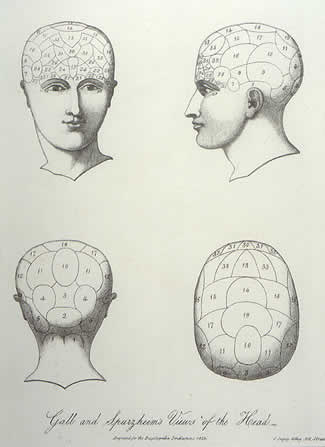
- The Reproductive Instinct – Physical or "Conjugal" Love
- Parental Love
- Friendship
- Combativeness: the disposition to quarrel or battle
- Destruction
- Guile: the inclination to keep secrets
- Acquisition: covetousness and the need to acquire (e.g. property, wealth, food)
- Self-Esteem, also arrogance and pride, self-love
- Approbation – the need to be accepted by others
- Caution
- Memory, educational ability
- Locality: Sense of place and proportion
- Form: Understanding of shapes
- Verbal Memory
- Sense of Speech and Language
- The ability to recognize and understand color
- Tune: organ of music and sound perception
- Number Calculation
- Constructiveness
- Comparison: The ability to compare
- Causality: The ability to understand the reasons behind events
- Wit
- Idealism
- Benevolence – compassion and kindness
- Imitation – the disposition for acting and drama
- Generation – the ability to generate new ideas
- Firmness – constancy and perseverance
- Time – the ability to gauge time
- Eventuality – this faculty recognizes the activities of other faculties and acts in turn upon all of them.
- Inhabitiveness – the instinct that prompts our attachment to our homes
- Reverence –adoration of God
- Conscientiousness
- Hope
- Marvelousness – belief in the doctrines of religion
- Size – the ability to recognize dimension in external objects
- Weight and resistance – recognition of an object's gravity
- Order- a faculty that gives method and order to objects as they are physically related.
The Spread of Phrenological Popularity
That the brain and not the soul was the seat of moral reason was a revolutionary theory for its time that challenged both the authority of the church and the crown. Austrian Emperor Francis I ordered Gall to stop his research. The royal demands caused Gall and Spurzheim to leave Vienna. After touring Europe for several years, Spurzheim split from Gall in 1813 and moved to England to further promote phrenological theory.
The theory of phrenology appeared to provide tangible evidence of character development. The new "science" quickly gained popular support. George Combe started the Edinburgh Phrenological Society in 1820. He published Combe's Phrenological Journal from 1823 until 1847. His book "The Constitution of Man" sold more than 300,000 copies. His book, "Combe's System of Phrenology" became a standard in British homes7.
Spurzheim traveled to the United States in 1832, touring the country to further promote phrenology. Lorenzo Fowler, his brother Orson, and business partner Samuel Wells published many phrenological pamphlets and materials. Their periodical, The American Phrenological Journal and Life Illustrated was published from 1838 until 19118.
"Phrenological Parlours" were popular throughout Europe and the USA between 1820 and 1842. "Phrenologists" were consulted for everything from hiring employees to choosing a spouse and for diagnosing both physical and mental afflictions6.
Phrenology attracted such notable figures as Horace Mann, Walt Whitman, Edgar Allan Poe, American President James Garfield, Karl Marx, Honoré de Balzac, Charlotte and Emily Bronté, George Eliot, and Otto von Bismark. Queen Victoria (1819-1901) employed a phrenologist to palpate the royal children's cranial bumps.
The Decline of Phrenology
Although the basic concept of phrenology—that the brain is the center of character development, emotion, and reason—was sound, the tangibility of phrenology soon fell out of favor with medical science. Easy application by self-taught "phrenologists" put it into the hands of quacks and other commercially exploitive entrepreneurs.
In 1931, Henry C. Lavery developed an automated phrenology machine, which he called a "psychograph". The helmet-shaped machine was placed on a person's head and a number of spring-loaded probes extended to the scalp and measured the topography of the skull. Then the machine released a ticker-tape set of statements taken from 160 different "possibilities". The psychograph debuted in 1934 in Chicago at the "Century of Progress Exposition" where it earned over $200,000 for Lavery and his partner Frank P. White. At least two of the machines have survived in working order. One is located at the Archives of the History of American Psychology at the University of Akron, Ohio and another is in Robert McCoy's Museum of Questionable Medical Devices in the Science Museum of Minnesota.
2. Patricia H. Bazemore, and Stephen M. Soreff. “Examining phrenology: this pseudoscience did have some influence on modern understanding of the brain.(IN RETROSPECT).” Article from Behavioral Healthcare 1 Jan 2007. 22 Aug 2008 <http://www.highbeam.com/doc/1G1-159594448.html>.
3. Douglas Harper. “Phrenology.” Online Etymology Dictionary. 2001. 22 Aug 2008 <http://www.etymonline.com/index.php?search=phrenology&searchmode=none>.
4. R. M. E. Sabbatini. “Phrenology: the History of Cerebral Localization.” Cerebromente 1997. 22 Aug 2008 <http://www.cerebromente.org.br/n01/frenolog/frenologia.htm>.
5. “Age of Enlightenment .” Wikipedia, the free encyclopedia. 2008. 23 Aug 2008 <http://en.wikipedia.org/wiki/Age_of_Enlightenment>.
6. Steven Novella. “Phrenology: History of a Classic Pseudoscience.” The New England Skeptical Society - Articles 1 Mar 2000. 22 Aug 2008 <http://www.theness.com/articles.asp?id=40>.
7. Ole Daniel Enersen. “Franz Joseph Gall .” Who Named It? 2008. 22 Aug 2008 <http://www.whonamedit.com/doctor.cfm/1018.html>.
8. Robert Todd Carroll. “phrenology.” The Skeptic's Dictionary 3 Dec 2007. 22 Aug 2008 <http://www.skepdic.com/phren.html>.